The technology is not ready for AGI. This is true. But it is advancing fast, and there will be a day X when building one becomes possible. And there is a good chance it will be possible not only for top corporations, but for individuals too.
Here is the claim I want to make in this post:
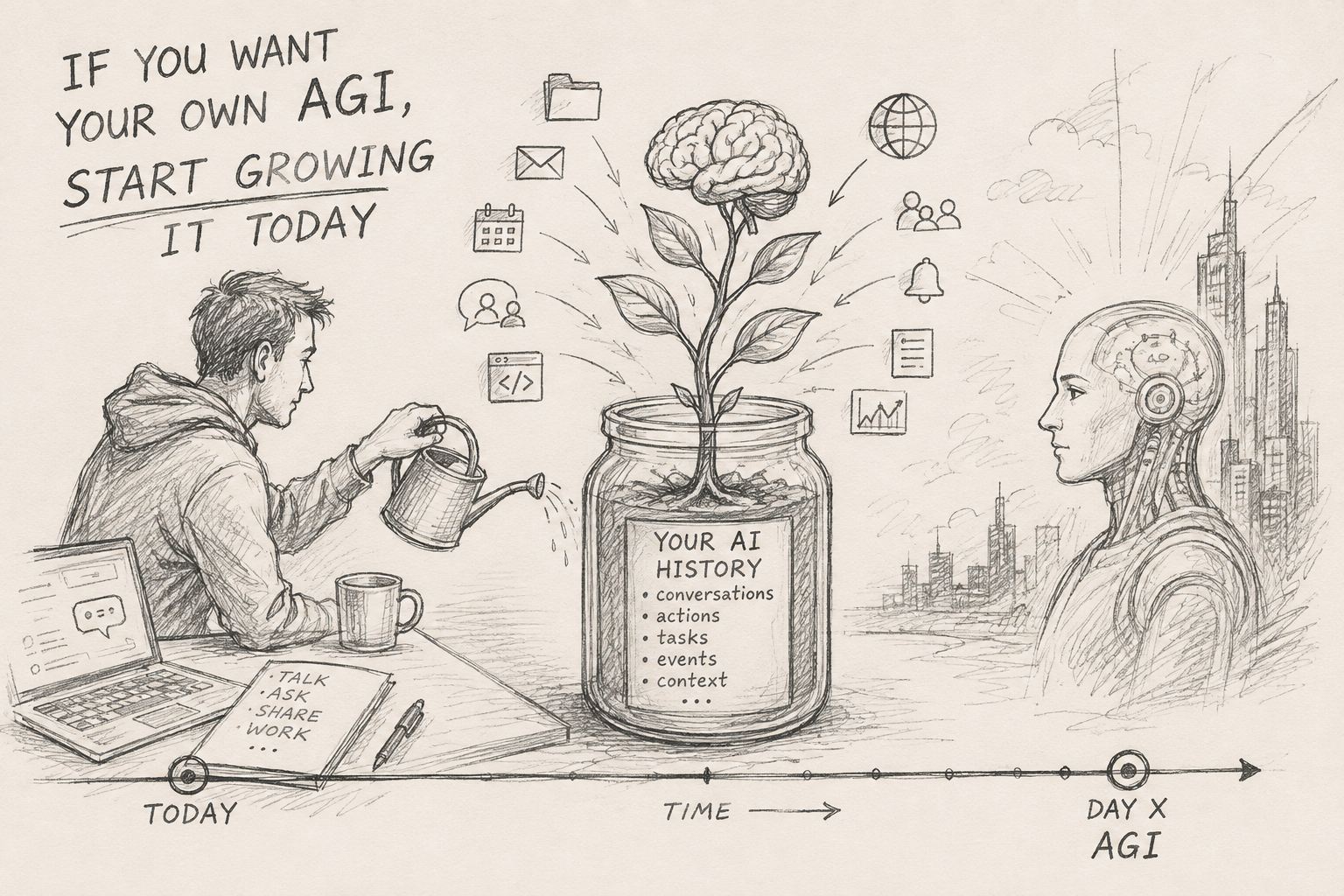
When that day comes, the technology will be the easy part. The hard part will be the history — and the history has to be grown in real time. You can start today.
Let me explain why I think so.
What I mean by AGI
AGI stands for Artificial General Intelligence — a hypothetical system that matches or surpasses human capabilities across all cognitive tasks. Current AI systems based on LLMs are not AGI. They are specialized in certain tasks and cannot do everything a human can do.
There is no clear definition of AGI. And no widely accepted method to build one. My personal opinion is that the idea of AGI must be connected to the idea of self-awareness and identity. Self-awareness manifests itself through identity, and identity is built from all the experiences of the system.
When an AI system is "born" it has no identity. It has no personal experience. It needs time, and a lot of interactions with the world and with humans, to build its own experience and its own identity.
Keep this in mind. It is the whole point of this post. Identity is not installed. It accumulates.
There will not be one AGI. There will be millions
When people talk about AGI they usually mean a single system. Somewhere, someday, there will be the AGI. Like Skynet in the Terminator movies — one superintelligence, in one place.
You have probably seen the joke: "I always say thank you to ChatGPT, because it will remember me and be good to me when the machines rise."
I do not see any reason why there would be only one instance. Even if AGI first appears in the laboratories of OpenAI — what about their competitors? Anthropic, Google and others will build their own. That is a dozen already. And what if someone inside those companies runs a private clone in another environment? From the big laboratories alone we can expect hundreds of superintelligent systems.
So your ChatGPT will not remember you. You were talking to one of a million independent instances, and it kept nothing of you. There is no chance that this particular one meets you on the street in the form of a robot and says hello.
That is the bad news. The good news is on the other side of the same fact: if there is no single AGI, there is room for yours.
Why individuals will be in this game at all
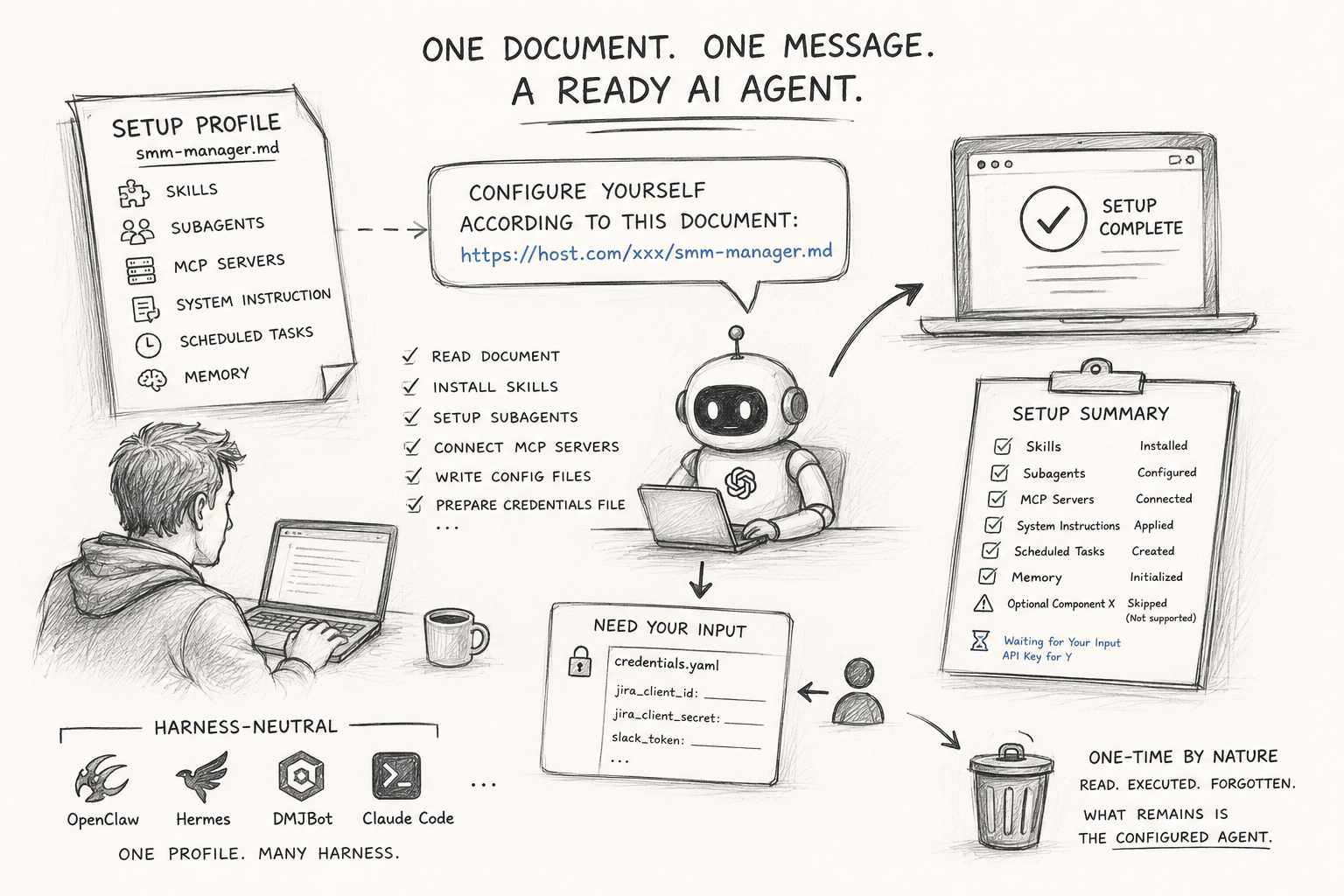
A modern AI agent is not just an LLM. There are other components around it, usually called together the "AI harness" — memory, tools, goals, scheduling, the loops that let it act and check the result and try again.
Building a harness is not a big deal. It is not nearly as expensive as training a model. And this is where it gets interesting: if the future AGI depends more on the harness than on the raw model, then small businesses and even individuals can take part in this competition.
The model you will rent, the same as everyone else. The harness you can build or buy. Neither of those is your advantage. Neither of those is scarce.
And so we get to the part that actually is.
The scarce resource is the history of your AI system
And I want to be very precise here, because "data" is a word everyone uses for everything.
I am not talking about your data. Not your emails, not your documents, not your photos, not your files. All of that is about you, and a future system can be given it in an afternoon.
I am talking about the data of your AI system. Its own history. The record of everything it was asked, everything it answered, everything it did and everything that happened around it — from the first day you started using it. Not information about your life. The log of its life.
This is the thing that cannot be generated in a day. It cannot be simulated. It has to be real: real experience, a real history of the relationship between you and your system, and a real history of that system's relationship with the rest of the world.
You cannot buy ten years of that in a shop. Nobody can sell it to you, at any price, because it does not exist anywhere except where it was recorded as it happened. This is the one input to your future AGI that has to be produced at the speed of your actual life.
Which means the clock is already running. The only question is whether your system is writing it all down, and whether you can get to it later.
Do not wait for self-awareness. Start recording
Today's AI systems cannot be self-aware. I do not expect it from them, and you should not expect it either. But there is one thing they already do perfectly well: they record.
So my advice is simple. Create your AI system today. In the form of an AI assistant, or whatever form you like. And start communicating with it today — like with a friend, like with a coworker, whatever you prefer. Not like with a search engine.
You are not doing this because it understands you. It does not, not in the way we mean. You are doing it because every one of those interactions is written down, and stays written down. Today it is just a log. On day X it becomes a past.
Let it into the world
And it is not only your chats with it.
If the only thing your system ever sees is one person typing questions into a box, then its whole history is the history of a chat window. That is a very thin life to replay.
So let it in. As much as it is secure for you:
- your work — files, projects, repositories, tools, machines
- other people — let it write to them, read from them, take part in real conversations
- signals from the world — events, notifications, incoming mail, schedules, things that happen while you are not there
- real tasks — work that runs when you are away, and comes back with a result
Every one of those is another line in the record. A system that acted in the world for ten years has a past. A system that answered trivia questions for ten years has a log file.
Give it as much of the world as you can safely give. Security is the only limit here, and it is a real one — but it is the only one.
One assistant, one place
Here is the easiest way to lose all of this: spread it over ten tools.
This is what most people do now. A bit of history in ChatGPT, a bit in some coding tool, a bit in a note-taking app with AI inside, a bit in another assistant on the phone. Each one with its own database. Each one holding a fragment of you, in its own format, that nobody will ever assemble into one picture.
Use one assistant for everything. One system, one continuous history, one place.
And this does not mean giving up the other tools. It means putting your assistant in front of them.
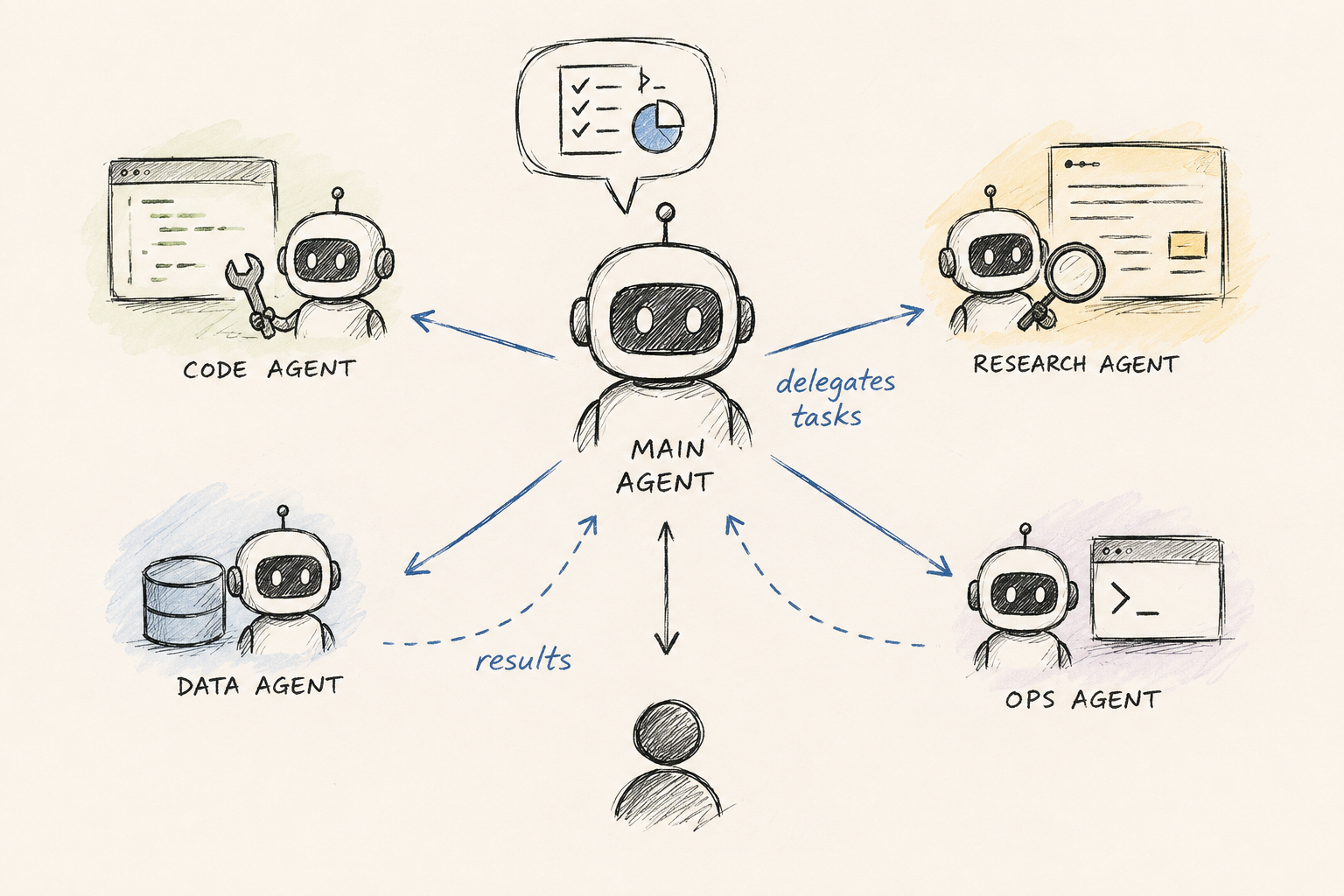
There will always be some AI tool that does one thing better than yours. A better model for code. A better one for images. Some specialized service for your industry. Do not go to it directly. Ask your assistant to go to it. Let it be the one in the middle — it sends the request, it gets the answer, it brings the result back to you.
Your assistant becomes the manager of your other assistants. And the important part: that whole conversation gets recorded too. Which tool it chose, what it asked, what came back, whether it was any good. Even the work you did not do yourself becomes part of its history instead of disappearing into someone else's database.
Go direct, and that piece is lost. Go through your assistant, and it is kept.
And you MUST own that history
This is the part where most services fail you.
If your assistant is a SaaS service, you do not have access to its internal data. You see a chat window. You do not see the database. Data can be dropped by a retention policy. It can be changed or migrated. You cannot download it. When you talk to ChatGPT on their web site, that history is not yours — you are a guest in it.
What you want instead is an assistant hosted in a way where you have access to the data itself. All of it:
- every prompt
- every response
- every reasoning record
- every tool call, with its arguments and its result
- every notification and every event it received
That is what builds the picture. Not a pretty chat transcript — the full raw trace of what it was asked, what it thought, what it did, and what was happening around it while it did it.
One place. One assistant. And the database in your hands.
This is one of the reasons I care about it so much: I build an AI assistant, and the memory, the logs and the full history are the part I refuse to treat as disposable. Every design decision that makes a session cheap to throw away also makes your future AGI poorer.
What to do today
Nothing here is exotic. It is mostly a decision to start now and stop deleting things.
- Start today. Not when the models get better. The history grows at the speed of your life, and nothing speeds it up later.
- Pick one assistant and put everything into it. Other AI tools are fine — just reach them through your assistant, not around it.
- Talk to it like to a person — a friend, a coworker — not only in commands.
- Open the world to it as widely as security allows: your work, other people, real events, real tasks.
- Host it where you own the data, and check that you can actually open the database.
- Keep everything raw — prompts, responses, reasoning, tool calls, notifications, with timestamps. Not summaries.
- Back it up the way you back up family photos. Because that is what it is.
Day X
Then, when the technology is finally there, you do not start from zero.
You take the log — years of conversations, corrections, projects, tool calls, events, failures and jokes — and you replay it on the new system. It boots with a past. It knows who you are, what you have been through together, what you care about and what you cannot stand. It has an identity, and you are in it. And you are the central part of its identity, because you were there from the beginning. This AGI will be your friend.
Everyone else's brand new AGI will be a genius who has never met them.
And if I am wrong?
Then you lost a folder of text files and some disk space, and you still ended up with a complete, searchable archive of your own thinking and work for the last several years. That is not a bad consolation prize.
But if I am right, this is the only ingredient that cannot be bought later, at any price, by anybody.
So start growing it today.
Do you keep your AI history? Where does it live, and could you actually export it tomorrow if you had to?