I am a regular user. I buy clothes online, I order food, I get things for the home. And, like most people, I have my favourite places. I go back to the same shops because I know them, because I trust them, and — often — because I have a discount or a loyalty price there.
Now watch what happens when I bring an AI assistant into this.
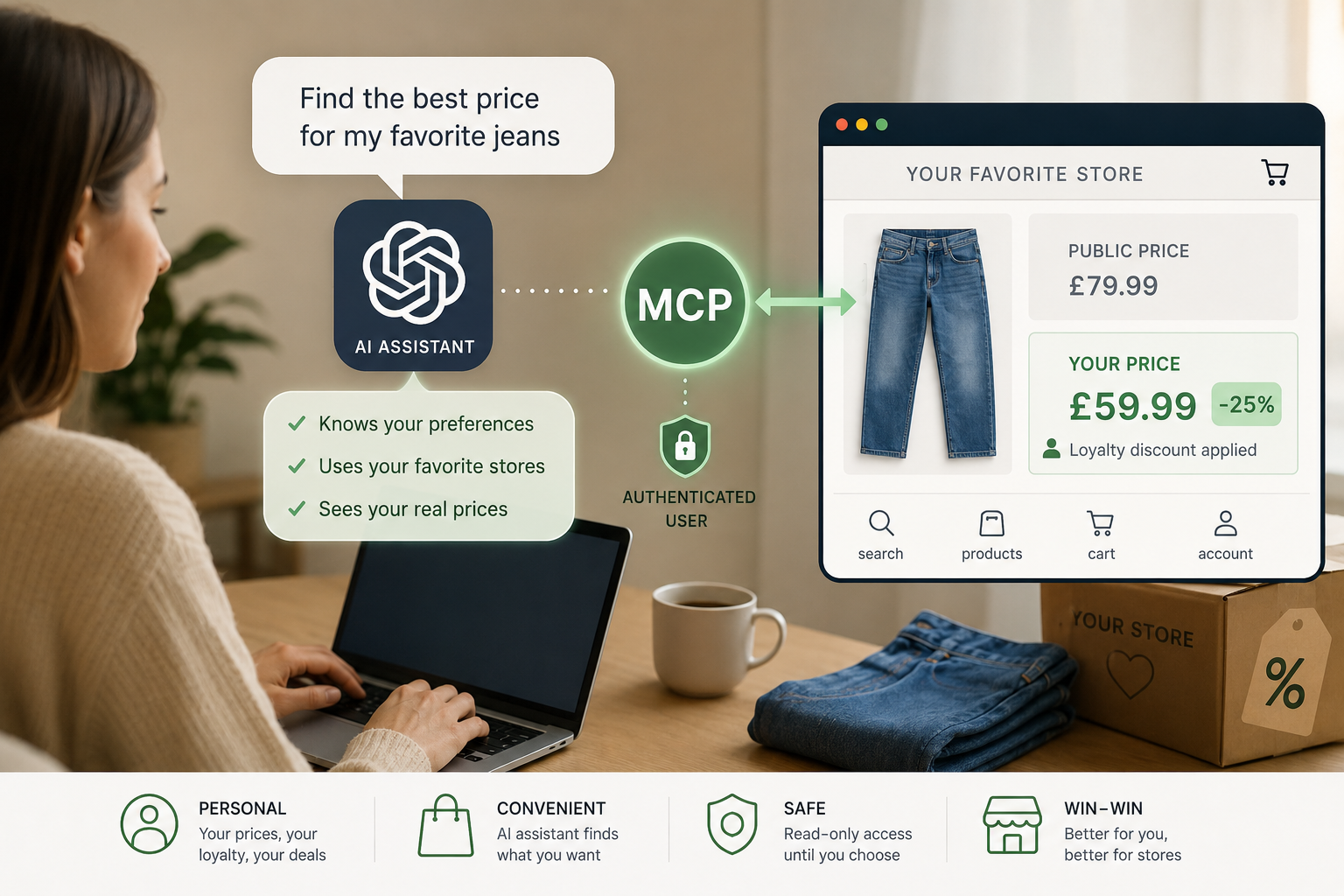
I open ChatGPT and ask it to find the best price for my favourite model of jeans. It runs a generic web search. It uses its own rules about where to look. Even if it happens to land on my favourite store, the price it shows me is the public price — not my price. My discount, my loyalty status, my active promo — none of that is there. The assistant has no idea I am me.
There are two problems tangled together here:
- My favourite store has no MCP interface. The agent can only use the open web, and sometimes a public API. There is no clean way for it to say "this user is a logged-in customer, show them their real prices."
- I can't easily teach the agent my preferences. I would love to just type in the chat: "When I ask you to find clothes, search on https://next.co.uk/ and https://www.riverisland.com/ first." And I'd expect it to remember that and do it next time. Today that is still awkward. For a regular, non-technical user it basically doesn't happen.
A prediction I got wrong
More than a year ago I wrote a post about how I expected MCP to change the web: MCP could significantly transform how we use the internet. My expectation was simple — websites would implement this interface in large numbers so that users could work with them from their own AI harness.
That prediction was wrong. It didn't happen.
I think there are a few reasons why, but I don't want to analyse them here. In this post I only want to show one thing: technically, this is easy to build.
How this could work
Imagine an online store implements the MCP protocol. Technically it is very easy and very safe. (I even have a separate post showing that MCP can work without a persistent connection — so this doesn't even require holding open sockets for every visitor.)
The site just adds a small <meta> tag to the HTML response of its home page:
<meta mcp="https://host.com/mcp" anon="true" auth="true">
Meaning: "We support MCP over this endpoint. Some tools are available anonymously, some tools require authorisation."
Why is anonymous access fine? Because there is no secret in a list of products. Search, browse, and product-info tools are just read-only web endpoints — the same data any visitor already sees in a browser.
The authorised level unlocks more: add to cart, and — importantly — prices adjusted for that specific user, based on their discounts, loyalty status, or active promotions.
So once an AI harness has a website URL, it can quickly check whether MCP is supported and then use it to access the data properly — instead of scraping and guessing.
The part that actually excites me
With this in place I could just tell my assistant:
"Monitor the price for this jeans model on xxx every day. When it drops during a sale, let me know immediately."
And it would work — against my price, on my store, with my discount.
This is a win-win. The user gets a real, personal shopping assistant. The merchant gets a new, well-behaved channel that brings loyal customers back and shows them the right price.
It's simple. It's safe. It's cheap to implement. So the only question I'm left with is:
What is stopping this from happening?
I can not understand it. All the infrastructure is ready.